We live in a culture obsessed with rapid resolution. We want life tidy, aligned, and optimized, and we want it yesterday. But when it comes to true reflection and introspection, the quick fix is usually the very thing breaking us.
The single biggest misconception people have about introspection is that it’s a solo, singular act—a solitary session where you dig inward, find a neat answer, and fix yourself in a vacuum. But real introspection doesn’t work through a single lens. It requires dialogue, multi-perspective honesty, and the willingness to sit in the awkwardness of a long, hard conversation.
When you look at your life solely through your own lens, you aren’t inspecting the room—you’re just staring into a mirror.
The Bottleneck and the Marble
For a long time, we’re taught to swallow our opinions or perform for peace. But when you are deeply passionate about resolving an issue—whether in a relationship or at work—and you’ve spent a lifetime being told to quiet down, a bottleneck forms.
It’s like a marble sitting in the neck of a glass bottle. Every time you try to pour out what you’re feeling, that marble stops the flow.
When you aren’t heard, the passion can’t escape smoothly. It combusts internally. What comes out might look like hostility or hostility to the outside world, but on the inside, it’s just the frustration of being silenced. If the other person takes a hierarchy in the conversation and directs the narrative, you aren’t reflecting together—you’re just adopting their view because it’s easier than fighting the bottleneck.
The Coaster vs. The Core: Reflection vs. Introspection
To navigate this without shutting down, you have to understand the difference between reflection and introspection.
- Reflection is situational. It’s placing a coaster down on a teak table. You know that hot mug of coffee will leave a burn mark on the raw wood, so you put a barrier down to protect the surface. In life, reflection is looking at a moment, a fallout, or a mistake, and deciding how to handle it better next time so you don’t burn the table.
- Introspection is foundational. It’s taking the mask off in total solitude and asking: Who am I when I’m not performing a role for anyone else? It’s stripping down to your absolute core—your faith, your values, your preferences—without needing a audience to validate them.
Introspection is learning what colors you actually like, what music touches you when no one is watching, and what your boundaries look like when you aren’t trying to keep the peace. It’s hard work, and it takes time spent in your own silence.
Sovereignty, Territory, and the Ball of Wool
Once you’ve done that deep introspection and defined your core, a new challenge appears: protecting it.
When someone enters your space—whether a new partner, a colleague, or a friend—they have to understand that taking a seat at your table is a gradual process. Too often, people try to rush in, saturating your space and offering a quick short-term endorphin hit. They try to tell you who you are, what you need, or how you should act.
If you’ve spent years getting comfortable in your own skin, that kind of invasion feels like a takeover. It becomes a dictatorship. Your internal system goes on high alert, and you become territorial over your own sovereignty.
That brings us to the ball of wool.
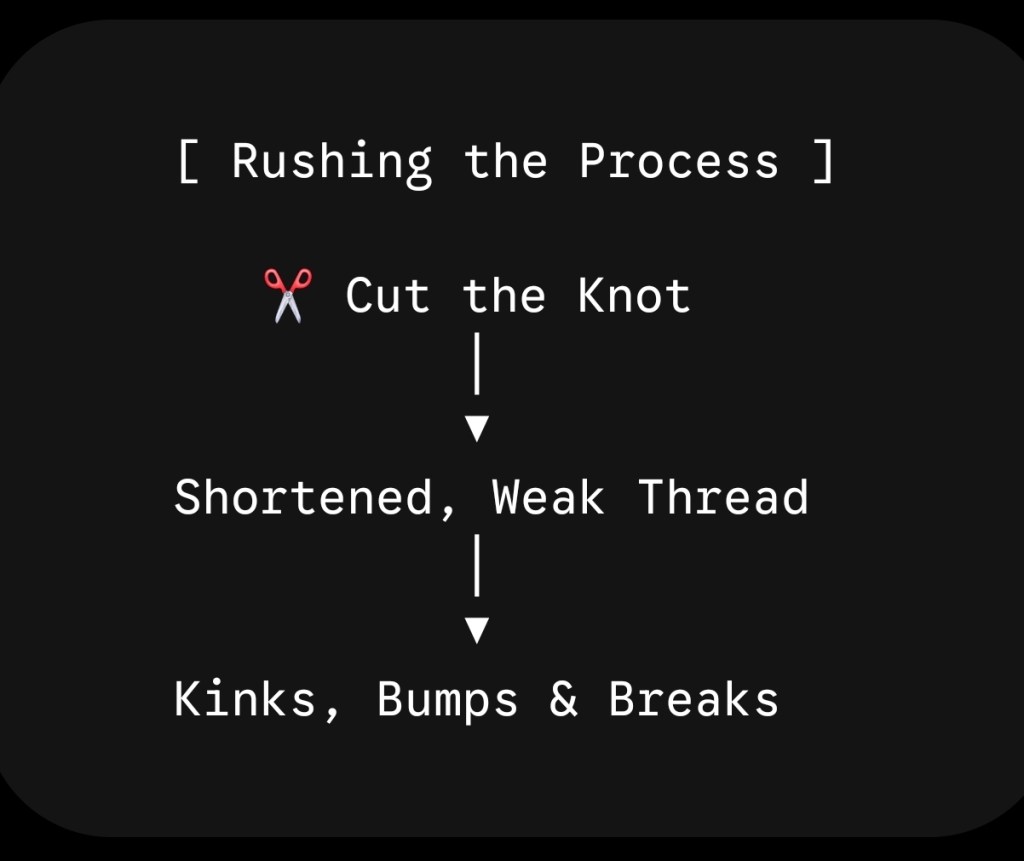
When things get tangled, most people just grab the scissors. They cut the knots out of the wool to get past the awkwardness quickly. But every time you cut a knot out, the thread gets shorter. Do it enough times, and you’re left with nothing to work with.Alternatively, some people dig straight into the center of the ball, hollowing themselves out from the inside until the outer shell caves in.Introspection isn’t about picking endlessly at old wounds or letting your past hold you hostage. Your past doesn’t control your future. It’s about inspecting the thread before it snaps.
When the Sweater Is Too Tight
How do you know when a boundary is actually being crossed versus your old defense mechanisms flaring up?
Listen to your body. It’s a physical sensation—a tightness.
It feels like wearing a sweater that simply doesn’t fit. It’s suffocating. You can try to force it, but the pattern is wrong. Boundaries are overstepped when a situation directly conflicts with your core values and beliefs. Just because someone else moves at a certain speed or demands a certain outcome doesn’t mean you have to fall in line.
When that tightness hits, you need a cooling-off period. You need space to step back, let your internal nervous system settle, and ask yourself the hard questions in private: Was I rational? Am I overthinking this? Or is this genuine incompatibility?
Taking time away isn’t running away; it’s giving yourself the quiet required to examine the weave.
Don’t Miss the Stitch
If there is one truth to hold onto, it is this: Do not rush the process.Life isn’t a straight, linear path. You can plan something today, and tomorrow a curveball will rewrite the priority list. That doesn’t mean you failed; it just means life is weaving.
If you rush the knitting just to get to the finished garment, you’ll drop a stitch. And a dropped stitch will eventually unravel the whole thing anyway.
Take your time. Work with finer materials—honesty, clear timing, multi-perspective dialogue, and deep self-respect. When you stop cutting the knots out and start giving yourself room to breathe, the finished product isn’t just something that looks good to the outside world—it’s something that actually fits.
 Jennifer Birdie Author
You must be logged in to post a comment.