
That persistent flutter in the pit of your stomach—the light-headed, electric, slightly uneasy vibration—is one of the most confusing sensory signals the human body produces. You are sitting at your desk, or standing in your kitchen, or looking across a dinner table, and you feel it. But what is it actually trying to say? Is it the dizzying excitement of a new romance, the sharp, threat-detecting spike of anxiety, or the quiet, persistent nudge of deep intuition?
Right now, as life shifts rapidly across work, family, and relationships, this physical sensation lingers. You cannot shake it off, no matter how rationally you try to talk yourself out of it.
To understand why this feeling is so sticky, it helps to ground it in a dual theoretical framework: Polyvagal Theory and Predictive Processing.
The Science Behind the Gut Signal
Under Polyvagal Theory (developed by Dr. Stephen Porges), our autonomic nervous system is constantly performing neuroception—scanning our environment, interactions, and internal states for cues of safety, danger, or excitement without involving our conscious mind.
♡ Butterflies occur when the sympathetic nervous system fires up in response to high anticipation or novel reward. Blood diverts away from your digestive system and toward your muscles, creating that weightless, fluttering sensation.
♡Anxiety shares this exact same physiological pathway, but with a crucial difference: neuroception has flagged a threat. The body prepares for fight-or-flight, turning that light flutter into a tight, heavy knot.
♡Intuition, physiologically speaking, is the somatic marker hypothesis in action (pioneered by neuroscientist Antonio Damasio). The brain stores patterns from every experience you have ever had. When a current situation mirrors a past pattern, the brain sends a rapid physical signal via the vagus nerve to the gut long before the conscious brain can articulate a reason.
Under the Predictive Processing model of cognitive neuroscience, the brain is a prediction machine. When life changes pace, the brain experiences a surge in “prediction errors”—gaps between what it expected and what is happening. The physical sensation in your stomach is the body’s raw energy signal registering those errors. The mind then tries to label that energy: Am I afraid? Am I in love? Am I in danger?
Translating the Signal Across Life’s Shifting Paces
When life changes speed, these three signals blur together. Deciphering them requires looking at where the energy is actually directing you.
1. New Romance
You are looking at someone across a room or waiting for a text, and your chest feels tight while your stomach flips.
- Butterflies: The feeling expands upward. It carries a sense of curiosity, hope, and vulnerability. It feels electric and forward-moving.
- Anxiety: The feeling turns inward and protective. It asks, “Am I safe? Am I going to get hurt? Am I good enough?”
- Intuition: A calm, quiet certainty underneath the excitement. It isn’t frantic. Even if the butterflies are loud, intuition is the subtle, steady knowing that tells you whether this person feels like home or like a repeating mistake.
2.Work & Changing Paces
A new project lands on your desk, or you step into a higher-level role. The pace accelerates, and the nervous system reacts immediately.
- Butterflies: You are at the edge of your growth zone. The flutter is excitement disguised as nervous energy because the stakes matter to you.
- Anxiety: Imposter syndrome takes the wheel. The physical sensation becomes restrictive, convincing you that a mistake will lead to disaster.
- Intuition: A clean, clear sense of alignment—or lack thereof. Intuition is the voice that whispers, “This path is right, even if it’s hard,” or conversely, “You are compromising your core values for this title.”
3.Family Dynamics
Family holds our deepest, oldest somatic patterns. A simple comment at a Sunday dinner can trigger an immediate bodily reaction.
Anxiety vs. Intuition: Here, anxiety is often a phantom of past experiences—reacting to old wounds rather than the present moment. Intuition, however, feels distinct from memory; it evaluates the current reality clearly, urging you to set a boundary or step back without panic or drama.
Keeping It Real: How to Distinguish Them in Real Time
When you cannot shake the feeling off, forcing yourself to “just relax” rarely works because the nervous system is actively processing data. Instead of trying to eliminate the sensation, test it with three simple questions:
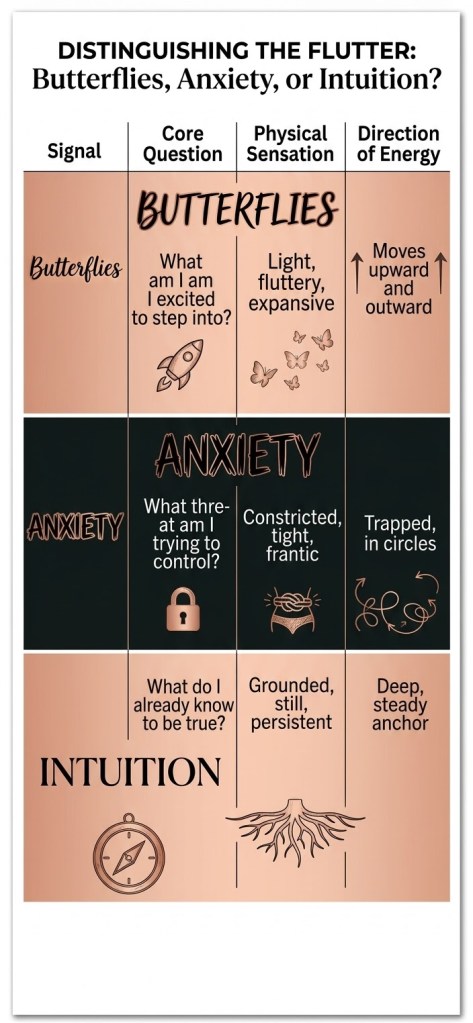
Living With the Flutter
The goal is not to eliminate the vibration in your gut, but to stop mislabeling it.
When you feel that persistent flutter today, pause before letting your mind construct a catastrophic narrative around it. Remind yourself that your nervous system is simply running at a high frame rate, processing new inputs across work, family, and love.
If the feeling is frantic and demanding, breathe through the anxiety. If it is expansive and slightly terrifying, ride the butterflies—they mean you are growing. And if it is a quiet, steady hum that refuses to go away no matter how much logic you throw at it, pay attention. That is your intuition telling you exactly where to step next.


Leave a comment